Racism Persists Even With Changing Attitudes About Cannabis
A shocking example of this comes in form of the arrest and subsequent abuse of business woman Kam Brock — a black woman who was pulled over while driving her BMW through Harlem.
Topic
310 articles
A shocking example of this comes in form of the arrest and subsequent abuse of business woman Kam Brock — a black woman who was pulled over while driving her BMW through Harlem.
Last week, Nevada state Senator Tick Segerblom introduced a bill in the Nevada legislature that would allow pets to use medical marijuana.
Researchers" relied on self reporting, which is historically not reliable and the study only looks at two forms of cannabis, skunk and hash.
Suspending children from school for drug use could actually encourage their classmates to smoke pot, rather than deter them. Suspensions have also been shown to increase disengagement from school, delinquency or anti-social behaviour such as smoking and alcohol use, but ...
Scientists have been studying 100 million year old grass found in Myanmar, cased in amber. The study's lead author stated that he's fairly certain that the infected grasses would have been eaten by sauropods.
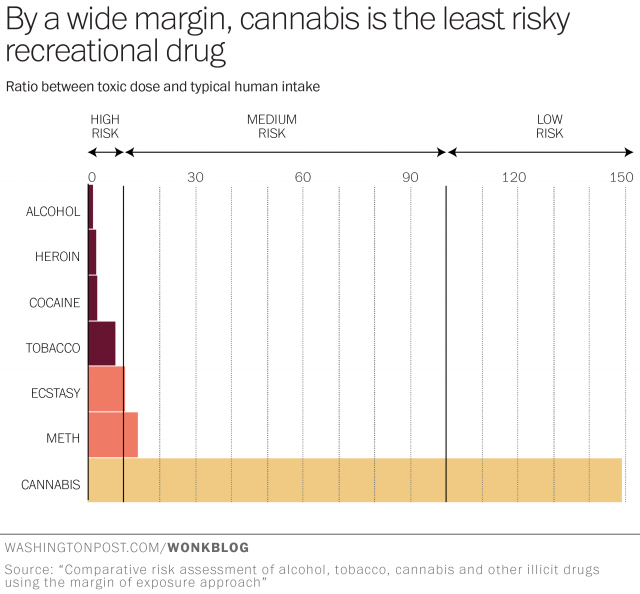
A study recently came out backing up what pro-cannabis advocates have known (and been screaming at naysayers) for decades: cannabis is safer than booze, tobacco and other drugs.
A new study was released last week showing that smoking skunk-type cannabis can increase the risk of psychotic episodes. Unfortunately for the researcher, and the legion of journalists who wrote about it without fact-checking the study, the study’s methodology and definitions are entirely hogwash.
Compared with other recreational drugs — including alcohol — marijuana may be even safer than previously thought. And researchers may be systematically underestimating risks associated with alcohol use. Those are the top-line findings of recent research published in the journal Scientific Reports, a subsidiary of Nature.
Many are familiar with this common effect of smoking cannabis, and scientists have recently set out to explain why smoking weed makes people so hungry. Researchers from the Yale School of Medicine recently published a study where they attempted to identify the area of the brain responsible for weedist's overwhelming desire to eat large quantities of food after smoking.
Apparently, researchers at the University of Warwick believe they have uncovered a "significant" link between cannabis use and mania symptoms. They suggest that their findings show cannabis use has both a causal link to mania as well as a magnifying effect on preexisting mania symptoms.
More bad news for the hysterical anti-pot crowd: the National Highway Traffic Safety Administration just released a report stating that driving after using cannabis does not increase your chances of getting into an accident.
Researchers at Washington University School of Medicine in St. Louis have recently conducted a detailed analysis of attitudes towards weed on Twitter. Their findings: Twitter loves the ganj.
In "the first large-scale study in the United States to include drugs other than alcohol," NHTSA found that, once the data were adjusted for confounding variables, cannabis consumption was not associated with an increased probability of getting into an accident.
A study recently released by scientists at the University of New South Wales' National Drug and Alcohol Research Centre illustrated that cannabis users reported significant pain relief from cannabis.
Colorado released a sweeping report Monday about marijuana and health — everything from pot’s effect on drivers, asthma, cancer rates and birth defects. The 188-page report doesn’t include new research on marijuana. Instead, it’s a review of what its authors call limited existing studies.
The revolutionary idea? Addiction is not caused by substances, rather, it is caused by isolation.
In this issue of Terpene Profiles, the properties of borneol are broken down and the therapeutic benefits are explored. Get to know this terpene and discover what studies are currently being done to determine its wide variety of medicinal benefits.
The industry created over ten thousand new jobs and brought in approximately $19 million a month. Rather than bringing about the end of society as we know it, cannabis legalization is only improving the job market and giving people a good time.